
How Does a Carbon Credit Exchange Reduce Carbon Emissions?
Carbon Credit Exchange Reduce Carbon Emissions
The global effort to reduce carbon emissions is gaining momentum, with more and more companies setting ambitious goals to go “net zero.” While it’s not easy for any company to eliminate all of its greenhouse-gas emissions, some businesses can lessen their emissions through carbon credits. These credits allow companies to offset their remaining emissions by purchasing the equivalent amount of carbon from projects that have reduced them already. There are currently two types of carbon credit exchanges: the voluntary and the regulatory market.
The voluntary market enables individuals and companies to purchase and sell carbon credits for their own reasons. Its recent rapid growth is fueled by corporate net-zero commitments and interest in meeting international climate goals set in the Paris Agreement.
Companies can generate carbon credit exchange from various projects that either reduce or remove greenhouse gases from the atmosphere, like reforestation or wind energy turbines. The carbon credits can then be sold to entities that want to offset their remaining emissions. The other major source of carbon credits is forestry, where trees are planted to sequester greenhouse gases from the air. These credits can also be sold to buyers who want to offset their emissions or who are required by regulations to do so.
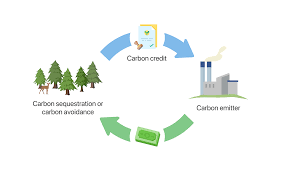
How Does a Carbon Credit Exchange Reduce Carbon Emissions?
Most of the world’s existing carbon markets are regulated, often by national or regional governments. They are often part of a wider program to limit carbon dioxide (CO2) emissions, known as a cap-and-trade system. Under these programs, regulators set a total limit on CO2 emissions for a given period of time and then give businesses the opportunity to trade permits in order to stay under that cap. These programs currently exist in several countries, including the U.S. states of California and New York, as well as the European Union member state of Norway.
While the current market for carbon credits is growing rapidly, it’s still in its infancy and faces significant challenges. A major problem is that the carbon market is highly heterogeneous, with each credit having its own unique attributes and characteristics. This makes matching an individual buyer with a supplier a difficult, inefficient process that is generally transacted over the counter rather than through an exchange.
One way to improve the efficiency of this market is to standardize a number of basic features that can be used to describe each type of credit. For example, creating common product labels for reforestation and forestry projects can simplify the matching process and ensure that all credit products are of the same quality. These standards could be based on core carbon principles and include attributes such as the size of the underlying project, the country of origin, and the vintage year.
Another important step would be to expand the supply of carbon credits, especially from emerging markets. To do this, more investment will be needed in a variety of projects, including those that provide other benefits to communities, such as food production and economic development. The ability to generate these additional co-benefits could help attract more buyers and increase the volume of carbon credits being traded.